Introduction
For years, SEO professionals focused heavily on keywords. The process was straightforward: identify relevant keywords, optimize website pages, build backlinks, and improve search rankings.
While keywords remain an important part of SEO, search engines have evolved significantly. Google and AI-powered platforms such as ChatGPT, Gemini, and Perplexity are increasingly focused on understanding the meaning behind searches, including the entities, relationships, and context associated with a query.
This shift is changing how businesses build online visibility. Instead of focusing only on individual keywords, businesses also need to establish clear connections between their brand, services, expertise, and industry.
Entity SEO plays an important role in this approach. It helps search engines understand what a business does, which topics it covers, and how its website content relates to other relevant concepts. It is also an important consideration for modern AI powered SEO services and long-term search visibility.
What Is an Entity?
An entity is a distinct person, place, organization, product, service, or concept that search engines can identify and understand.
Examples of entities include:
- A company
- A person
- A product
- A service
- A location
- A brand
- An organization
- A concept
For example, Google can recognize Apple as a company, New York as a city, Amazon as a company, SEO as a marketing discipline, and ChatGPT as an AI platform.
Entities help search engines understand meaning rather than simply matching words. They provide context that helps distinguish between different meanings of the same term.
This understanding allows search engines to connect related information and deliver results that better match what users are looking for.
Keywords vs. Entities
Understanding the difference between keywords and entities is essential to understanding Entity SEO.
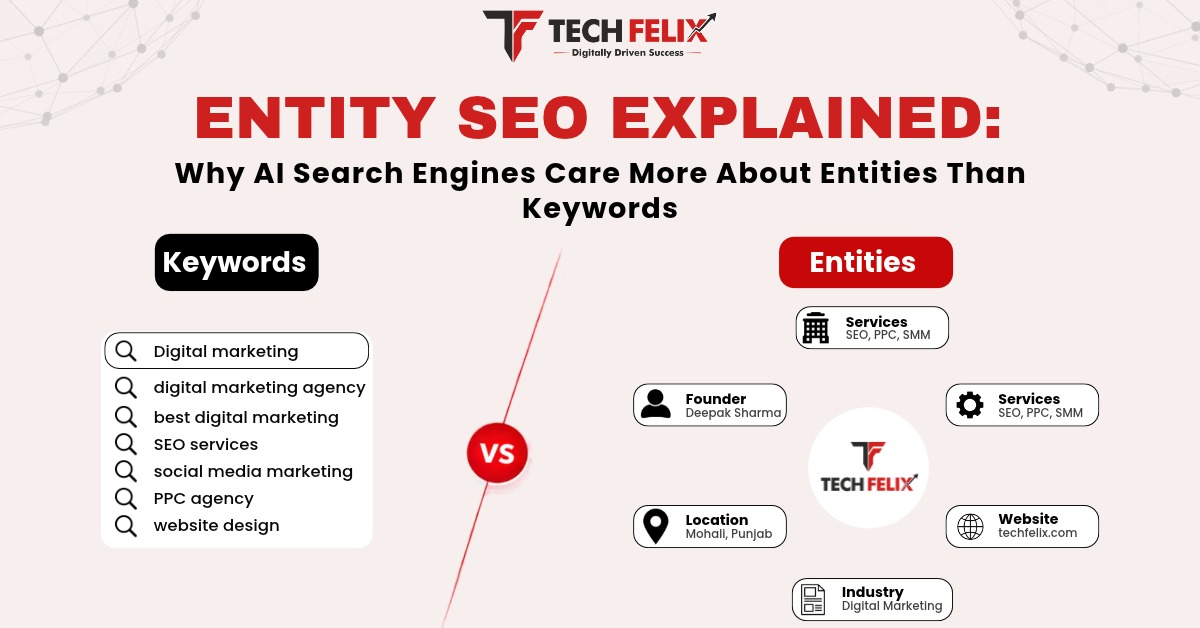
Traditional Keyword Approach
A business might target keywords such as:
- SEO company
- SEO agency
- SEO consultant
- SEO services
These phrases represent different search terms that people may use when looking for search engine optimization solutions.
Entity-Based Approach
An entity-based approach looks beyond individual keywords and considers the broader concepts connected to them.
For example, SEO company, SEO agency, and SEO services are closely related to the broader concept of Search Engine Optimization.
A business may also be associated with related topics such as technical SEO, content marketing, link building, and AI SEO.
Instead of treating every page or keyword as an isolated element, entity-based optimization focuses on building meaningful connections between a business, its services, and its areas of expertise.
This approach complements traditional keyword optimization and helps businesses looking for the best SEO company in India understand the importance of a comprehensive SEO strategy.
Why Search Engines Prefer Entities
Keywords can have multiple meanings, while entities provide additional context.
Consider the keyword “Apple.” Depending on the search query, a user could be referring to Apple Inc., the fruit, or Apple products.
Search engines use context and other available signals to determine the most relevant interpretation.
This understanding improves search relevance and helps users find information that matches their intent.
AI-powered search systems also need to understand context when responding to conversational queries. When users ask questions naturally, these systems must identify the relevant organizations, products, services, and relationships to provide useful answers.
Entity understanding helps connect these different elements and interpret what a user is actually asking.
How Google Uses Entities
Google’s Knowledge Graph is an example of how search engines organize information about entities and their relationships. Google can use available information to understand who a company is, what it offers, which topics it covers, and how it relates to other entities.
For example, an SEO agency may be associated with technical SEO, link building, content marketing, local SEO, and AI SEO. When a website clearly explains these services and provides relevant supporting content, it gives search engines more context about the business and its expertise.
This is one reason businesses create content clusters around their main services. For example, Tech Felix has dedicated pages covering:
- Technical SEO Services
- On-Page SEO Services
- Off-Page SEO Services
- Local SEO Services
- Link Building Services
These pages explain related areas of SEO and help visitors navigate the website according to their requirements. Together with relevant supporting content, they can also help search engines understand the relationship between a company’s services and its broader expertise.
Why Entity SEO Matters for AI Search
AI-powered search systems need to understand the context behind a user’s question rather than rely only on matching exact phrases.
For example, when someone asks, “Which SEO agency should I hire for my ecommerce business?”, an AI system needs to interpret the relationship between SEO, ecommerce, digital marketing, and search optimization.
Clear information about a business, its services, and its areas of expertise can help AI systems understand its relevance to particular topics.
However, strong entity signals do not guarantee that a business will be mentioned in AI-generated answers. Visibility depends on multiple factors, and no single optimization technique guarantees inclusion.
Businesses working on AI search visibility can therefore consider entity development alongside content quality, technical SEO, and other established optimization practices.
How to Build Strong Entity Signals
1. Create Comprehensive Service Pages
Every major service should have a dedicated page that clearly explains what the service involves, who it is for, and how it addresses customer requirements.
For example, a business offering AI SEO, search engine optimization, content marketing, and SEO content writing should explain each service separately while maintaining a clear connection to its overall expertise.
Each page should provide useful information, relevant headings, and clear explanations instead of repeating similar content across multiple URLs.
This structure helps visitors understand the business and gives search engines additional context about its services.
2. Build Topical Authority
Entity SEO works well alongside topical authority.
Instead of publishing unrelated articles, businesses can create a structured collection of content around their main topics and areas of expertise.
For example, an AI search optimization content cluster could include:
- How ChatGPT Finds and Mentions Websites
- How Google AI Overviews Impact SEO
- GEO vs. Traditional SEO
- Entity SEO Explained
- How to Rank in AI Search Results
Each article should address a distinct question while connecting naturally with related content where useful.
This approach creates a clearer content structure and helps visitors explore related topics without unnecessary repetition.
3. Use Consistent Branding
A business’s name and core information should remain consistent across its website and other online platforms.
Important places to maintain consistent branding include:
- Website pages
- Social media profiles
- Business directories
- Review platforms
- Guest articles
Consistent information makes it easier for users and search engines to connect references to the same business across different sources.
Businesses should review their online profiles regularly and correct outdated or conflicting details wherever possible.
4. Strengthen Author Profiles
Author profiles can provide useful context about the people responsible for creating website content.
A clear author profile may include:
- Professional experience
- Industry background
- Relevant credentials
- Areas of specialization
These details help readers understand the author’s background and provide additional context about the expertise behind the content.
Author information should be accurate, relevant, and consistent with the person’s actual experience.
How Brand Mentions Strengthen Entities
A common misconception in SEO is that backlinks are the only important way to build online authority.
Brand mentions can also help establish a business’s presence across the web. When a company is discussed on relevant industry websites, blogs, news publications, podcasts, interviews, and community platforms, those references can provide additional context about its identity and expertise.
The value of a mention depends on its relevance, context, and credibility. Not every mention automatically improves rankings or guarantees recognition by search engines.
Businesses can also pay attention to their online reputation and how customers describe their experiences.
For example, brand reputation management can help businesses monitor their online presence, manage brand perception, and respond to customer feedback while maintaining accurate information across relevant platforms.
The Role of Structured Data in Entity SEO
Structured data provides search engines with information about the content and entities represented on a webpage.
Depending on the page and its purpose, useful schema types may include:
- Organization Schema
- Local Business Schema
- Service Schema
- FAQ Schema
- Review Schema
- Person Schema
- Article Schema
Each schema type serves a particular purpose. For example, Organization Schema can describe a business, Person Schema can provide information about an individual, and Article Schema can describe an article’s content and authorship details.
Structured data should accurately reflect the visible content and the entities represented on the page. Adding schema alone does not establish authority or guarantee enhanced search results.
A technical review can help identify relevant structured data opportunities, implementation issues, and other website improvements. Businesses can address these requirements through a structured SEO audit.
Why Internal Linking Supports Entity SEO
Internal linking connects related pages within a website and helps visitors discover additional information.
For example, an article explaining Entity SEO may naturally link to a relevant AI SEO service page, a technical SEO resource, or a content marketing page when the destination provides useful information for the reader.
These links help establish relationships between related topics and make website navigation more effective.
However, internal linking should be based on relevance rather than the number of links added to a page.
A useful internal linking strategy should:
- Connect related pages naturally.
- Use descriptive anchor text.
- Help visitors find additional relevant information.
- Avoid unnecessary links to unrelated services.
- Maintain a clear website hierarchy.
When implemented thoughtfully, internal links support content discovery and help search engines understand how different sections of a website relate to one another.
Common Entity SEO Mistakes
Focusing Only on Keywords
Keywords remain important, but optimizing only for individual phrases can overlook the context and relationships that help explain a business’s expertise.
Publishing Random Content
Publishing articles without a clear connection to the website’s main topics can make the overall content structure less coherent.
Creating Weak Service Pages
Thin or unclear service pages may not adequately explain what a business offers. Each important service should have useful, relevant information.
Ignoring Brand Building
A business’s online presence extends beyond its website. Consistent branding and relevant external references help establish a clearer identity.
Maintaining Inconsistent Business Information
Conflicting business names, descriptions, or other details across online platforms can make it harder to connect references to the same organization.
Neglecting Reviews and Reputation
Customer feedback and online reputation influence how people perceive a business. Companies should monitor relevant reviews and respond appropriately to customer concerns.
How Entity SEO Supports International Growth
Businesses serving customers in multiple countries can use Entity SEO alongside their broader international search strategy.
A business based in India may serve customers in the United States, United Kingdom, Canada, Australia, the UAE, and Europe. To communicate its expertise effectively, it needs clear information about its identity, services, and target audiences.
Entity SEO can complement international targeting by helping establish consistent brand information and meaningful connections between the business and its services.
Businesses planning to expand across different countries can combine these efforts with global SEO services to address market-specific keyword research, website structure, hreflang implementation, and content localization.
Entity development and international SEO address different aspects of search visibility, but they can work together as part of a broader optimization strategy.
The Future of SEO Is About More Than Keywords
Keywords remain a fundamental part of search optimization, but modern SEO also requires a clear understanding of context, relationships, expertise, and relevance.
Search engines and AI-powered platforms continue to develop their ability to interpret information and connect related concepts. As a result, businesses should focus on building useful content, maintaining consistent branding, explaining their services clearly, and creating meaningful connections between related pages.
Rather than abandoning keyword optimization, businesses should combine it with entity-focused strategies that support a more complete understanding of their brand and expertise.
Conclusion
Entity SEO is becoming an important part of modern search visibility. As search engines and AI-powered platforms continue to evolve, businesses need to focus on more than individual keywords. They should also make it easier for search systems and users to understand who they are, what they offer, and which topics they specialize in.
Building comprehensive service pages, developing topical authority, maintaining consistent branding, strengthening author profiles, managing online reputation, and implementing relevant structured data can all contribute to a clearer online presence.
For businesses looking to improve their visibility across traditional search results and AI-powered platforms, Entity SEO can complement established SEO practices and support long-term optimization efforts.
Explore Tech Felix AI SEO Services to learn how AI-focused search optimization can fit into your broader SEO strategy.