Introduction
Search engine optimization has evolved dramatically over the last few years. For decades, businesses focused on one goal: ranking higher in search engines like Google Bing and Yahoo. The formula was relatively straightforward. Optimize pages, build backlinks, improve technical SEO, and earn higher rankings.
Today, the search landscape is changing. Users are no longer relying solely on traditional search engines. Instead, they are increasingly turning to AI-powered platforms such as ChatGPT, Google AI Overviews, Gemini, Perplexity, Claude, and other conversational search tools to find information, compare products, and make purchasing decisions. This shift has introduced a new discipline known as Generative Engine Optimization (GEO).
Many businesses now ask:
- Is SEO still important?
- What is GEO?
- How is GEO different from traditional SEO?
- Do I need both SEO and GEO?
- Which strategy should I prioritize?
The reality is that GEO is not replacing SEO. Instead, it is expanding the way businesses think about online visibility. Companies investing in AI-focused search strategies through AI SEO Services are discovering that success in modern search requires optimizing for both traditional rankings and AI-generated answers.
What Is Traditional SEO?
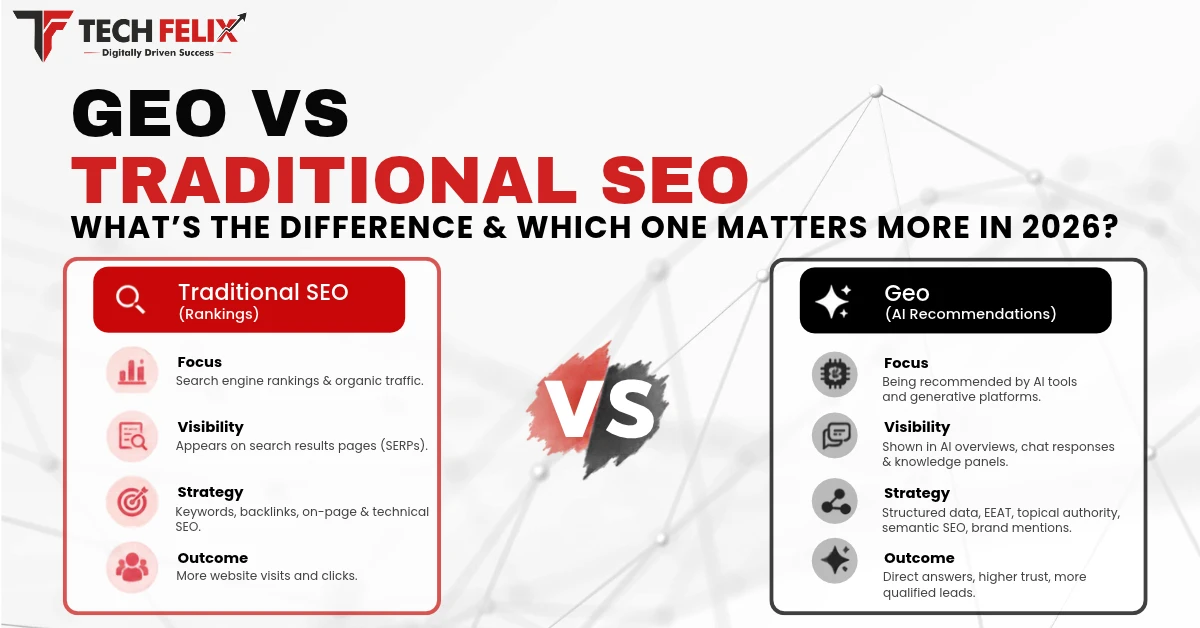
Traditional SEO refers to the process of optimizing a website to improve visibility in search engine results pages (SERPs). The primary objective is to rank web pages for relevant keywords and attract organic traffic.
Traditional SEO typically focuses on:
- Keyword research
- On-page optimization
- Technical SEO
- Link building
- Content creation
- User experience
- Internal linking
For example, a business targeting the keyword “SEO agency” may create optimized service pages, publish supporting content, build backlinks, and improve technical performance to increase rankings.
Businesses often use SEO Services to improve rankings, traffic, and lead generation through organic search.
Traditional SEO remains one of the most effective long-term marketing channels available.
What Is Generative Engine Optimization (GEO)?
Generative Engine Optimization (GEO) focuses on increasing visibility within AI-generated responses. Instead of trying to rank pages, GEO aims to improve the likelihood that AI systems mention, cite, recommend, or reference a business when generating answers.
Examples include:
- ChatGPT recommendations
- Google AI Overview citations
- Gemini-generated answers
- Perplexity references
- AI-powered search summaries
When a user asks:
“Which SEO agency is best for SaaS companies?”
AI systems may generate a direct answer rather than displaying a list of websites.
GEO helps businesses become part of those answers.
Organizations increasingly invest in AI SEO Services because AI-driven discovery is becoming a significant source of visibility and brand awareness.
The Core Difference Between SEO and GEO
The biggest difference is simple.
Traditional SEO optimizes for rankings.
GEO optimizes for recommendations.
SEO asks:
“How can I rank higher?”
GEO asks:
“How can I become a trusted source that AI systems choose to mention?”
Both strategies overlap, but their objectives are different.
A page can rank highly without being frequently cited by AI.
Likewise, a trusted brand may appear in AI-generated answers even if it does not dominate every search result.
SEO Focuses on Keywords
Traditional SEO relies heavily on keyword optimization.
Businesses identify search terms users enter into search engines and create content around those topics.
Examples include:
- Technical SEO Services
- Local SEO Company
- Ecommerce SEO Agency
- SEO Audit Services
Keyword optimization remains important because search engines still need to understand page relevance.
Businesses offering Technical SEO Services often focus heavily on keyword mapping, content architecture, and search intent alignment.
However, keywords alone are no longer enough.
GEO Focuses on Entities
AI systems increasingly understand entities rather than just keywords.
An entity can be:
- A company
- A service
- A product
- A person
- A location
- A concept
For example:
TechFelix may be associated with:
- SEO Services
- AI SEO
- Technical SEO
- Content Marketing
- Digital Marketing
The stronger these associations become, the easier it is for AI systems to understand what your business specializes in. This concept is commonly known as Entity SEO.
Strong entity development often supports both traditional SEO and AI visibility.
SEO Prioritizes Rankings
In traditional SEO, success is often measured using:
- Rankings
- Organic traffic
- Click-through rates
- Conversions
- Search visibility
For years, ranking in the top three positions was the primary goal.
Higher rankings generally meant more traffic.
Businesses regularly use SEO Audit Services to identify opportunities for improving rankings and search performance.
These metrics remain valuable today.
GEO Prioritizes Mentions and Citations
GEO introduces new visibility metrics.
Instead of focusing exclusively on rankings, businesses should also consider:
- AI mentions
- AI citations
- Brand recognition
- Entity authority
- Knowledge graph associations
- Industry references
A company that consistently appears in AI-generated answers can build trust and awareness even if users never perform a traditional search.
This represents one of the biggest shifts in modern search marketing.
Content Strategy: SEO vs GEO
Traditional SEO content often focuses on ranking opportunities.
Examples include:
- What Is Technical SEO?
- Local SEO Checklist
- SEO Audit Guide
GEO content goes deeper.
AI systems prefer comprehensive resources that demonstrate expertise.
Examples include:
- How ChatGPT Finds and Mentions Websites
- How Google AI Overviews Impact SEO
- How to Build Authority for AI Search
- Entity SEO Explained
This is why businesses increasingly invest in Content Marketing Services and SEO Content Writing Services to create authoritative content ecosystems rather than isolated blog posts.
Link Building in SEO vs GEO
Backlinks remain important.
Search engines still use links to evaluate authority and trust.
However, GEO introduces additional signals.
AI systems may also consider:
- Brand mentions
- Reviews
- Citations
- Industry references
- Community discussions
A business can strengthen authority not only through Link Building Services but also through broader reputation-building efforts.
The future belongs to brands, not just websites.
Why Brand Authority Is Becoming More Important
One of the most significant changes in AI search is the growing importance of brand authority.
AI systems frequently rely on recognizable, trusted entities.
Businesses that consistently publish valuable content, earn mentions, and demonstrate expertise tend to gain stronger visibility.
Brand authority can be strengthened through:
- Original research
- Case studies
- Reviews
- Thought leadership
- Public relations
- Industry participation
Organizations often improve these signals through Online Reputation Management Services and Review Management Services.
Which Matters More in 2026?
The answer is both.
Businesses should not choose between SEO and GEO.
They should integrate them.
SEO provides:
- Organic traffic
- Search visibility
- Lead generation
- Long-term growth
GEO provides:
- AI visibility
- Brand recognition
- AI citations
- Future-proof search presence
Companies that combine both approaches will likely outperform competitors relying on only one strategy.
The Ideal Strategy for Businesses
A balanced approach should include:
- Strong Technical Foundation
- Comprehensive SEO Strategy
- AI Visibility Optimization
- Content Authority Development
- Reputation Building
Together, these initiatives help businesses succeed in both traditional search engines and AI-powered search platforms.
Conclusion
Generative Engine Optimization and traditional SEO are not competitors. They are complementary strategies designed for different search environments. Traditional SEO helps businesses rank in search results, while GEO helps businesses become trusted sources within AI-generated answers. As search continues to evolve, businesses that invest in authority, expertise, technical optimization, and entity development will be best positioned to succeed.
The future of visibility is no longer limited to rankings. It is about becoming the source that both users and AI systems trust. If your goal is to improve visibility across Google Search, Google AI Overviews, ChatGPT, Gemini, and other AI-driven platforms, Tech Felix combines SEO Services with AI SEO Services to help your business build authority and stay visible across traditional and AI-powered search.